Beef Cattle Branding Areas Beef Cattle Branding Areas Labled
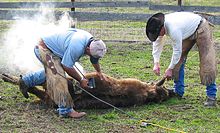
A young steer is being branded with an electrical branding iron and cut to make an earmark.
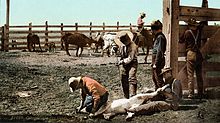
Branding calves in Colorado, c. 1900. Photochrom print

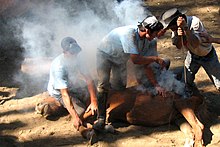
Hot fe horse branding, Spain

Modernistic portable table calf branding cradle, NSW, Commonwealth of australia

A stud Merino ram that has been branded on his horn.
Livestock branding is a technique for marking livestock so as to identify the owner. Originally, livestock branding but referred to hot branding large stock with a branding iron, though the term now includes culling techniques. Other forms of livestock identification include freeze branding, inner lip or ear tattoos, earmarking, ear tagging, and radio-frequency identification (RFID), which is tagging with a microchip implant. The semi-permanent paint markings used to identify sheep are called a paint or color make. In the American West, branding evolved into a complex marking organisation still in use today.
History [edit]
The act of marking livestock with burn-heated marks to identify ownership has origins in aboriginal times, with use dating back to the ancient Egyptians effectually 2,700 BCE.[one] Amidst the ancient Romans, the symbols used for brands were sometimes chosen as part of a magic spell aimed at protecting animals from harm.[two]
In English lexicon, the word "brand", common to most Germanic languages (from which root besides comes "burn", cf. German Brand "called-for, burn"), originally meant anything hot or called-for, such every bit a "firebrand", a called-for stick. By the European Eye Ages, it usually identified the process of called-for a mark into stock animals with thick hides, such as cattle, and then equally to identify buying under animus revertendi. The practise became specially widespread in nations with big cattle grazing regions, such as Spain.
These European customs were imported to the Americas and were farther refined by the vaquero tradition in what today is the southwestern United States and northern Mexico. In the American West, a "branding iron" consisted of an fe rod with a simple symbol or mark, which cowboys heated in a fire. After the branding iron turned red hot, the cowboy pressed the branding fe against the hide of the moo-cow. The unique make meant that cattle endemic by multiple ranches could so graze freely together on the open range. Cowboys could then separate the cattle at "roundup" fourth dimension for driving to market. Cattle rustlers using running irons were ingenious in irresolute brands.[3] The most famous brand change involved the making of the 10 I T brand into the Star-Cross brand, a star with a cross inside.[4] [v] Brands became and so numerous that it became necessary to record them in books that the ranchers could conduct in their pockets. Laws were passed requiring the registration of brands, and the inspection of cattle driven through various territories. Penalties were imposed on those who failed to obtain a bill of sale with a list of brands on the animals purchased.[half dozen]
From the Americas, many cattle branding traditions and techniques spread to Australia, where a distinct ready of traditions and techniques adult. Livestock branding has been practiced in Commonwealth of australia since 1866, merely afterwards 1897 owners had to register their brands. These fire and paint brands could non then exist duplicated legally.
Modern utilize [edit]
Free-range or open-range grazing is less mutual today than in the by. Nevertheless, branding still has its uses. The main purpose is in proving ownership of lost or stolen animals. Many western US states have strict laws regarding brands, including brand registration, and require brand inspections. In many cases, a brand on an creature is considered prima facie proof of ownership. (Run into Brand Book)
In the hides and leather manufacture, brands are treated every bit a defect, and can diminish the value of hides. This industry has a number of traditional terms relating to the type of make on a hibernate. "Colorado branded" (slang "Collie") refers to placement of a brand on the side of an animal, although this does not necessarily point the animal is from Colorado. "Butt branded" refers to a hide which has had a brand placed on the portion of the skin covering the rump expanse of the animal. A cleanskin beast is i without a brand while the skin without a brand is native.[7]
Exterior of the livestock industry, hot branding was used in 2003 by tortoise researchers to provide a permanent means of unique identification of individual Galapagos tortoises beingness studied. In this case, the brand was applied to the rear of the tortoises' shells. This technique has since been superseded by implanted PIT microchips (combined with ID numbers painted on the shell).[8]
Methods [edit]
The traditional cowboy or stockman captured and secured an brute for branding by roping it, laying it over on the ground, tying its legs together, and applying a branding fe that had been heated in a burn down. Modern ranch exercise has moved toward use of chutes where animals can be run into a confined area and safely secured while the brand is applied. Two types of restraint are the cattle beat or clasp chute (for larger cattle), which may close on either side of a continuing animal, or a branding cradle, where calves are caught in a cradle which is rotated so that the animal is lying on its side.
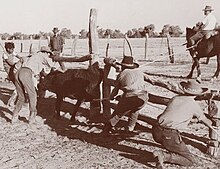
Bronco branding is an old method of catching cleanskin (unbranded) cattle on Elevation End cattle stations for branding in Commonwealth of australia. A heavy equus caballus, usually with some draught equus caballus bloodlines and typically fitted with a harness equus caballus neckband, is used to rope the selected dogie. The dogie is then pulled up to several sloping topped panels and a mail service constructed for the purpose in the centre of the yard. The unmounted stockmen then apply leg ropes and pull information technology to the basis to exist branded, earmarked and castrated (if a bull) there. With the advent of portable cradles, this method of branding has been more often than not phased out on stations. Notwithstanding, at that place are now quite a few bronco branding competitions at rodeos and campdrafting days, etc.[ix]
Some ranches still estrus branding irons in a wood or coal fire; others employ an electrical branding iron or electric sources to estrus a traditional atomic number 26. Gas-fired branding atomic number 26 heaters are quite popular in Australia, as iron temperatures can exist regulated and there is not the heat of a nearby fire. Regardless of heating method, the iron is only applied for the amount of fourth dimension needed to remove all pilus and create a permanent marking. Branding irons are practical for a longer fourth dimension to cattle than to horses, due to the differing thicknesses of their skins. If a make is practical as well long, it can damage the skin also deeply, thus requiring handling for potential infection and longer-term healing. Branding moisture stock may result in the smudging of the make. Brand identification may be difficult on long-haired animals, and may necessitate clipping of the area to view the brand.
Horses may likewise exist branded on their hooves,[10] only this is not a permanent mark, and then needs to exist redone about every half dozen months. In the military machine, some brands indicated the horses' army and squadron numbers. These identification numbers were used on British regular army horses then dead horses on the battlefield could be identified. The hooves of the dead horses were and then removed and returned to the Horse Guards with a request for replacements. This method was used to prevent fraudulent requests for horses.[11] Merino rams and bulls are sometimes firebranded on their horns for permanent individual identification.
Temporary branding [edit]
Some types of identification are not permanent. Temporary branding may exist achieved past heat branding and so that the hair is burned, but the pare is non damaged. Considering this persists merely until the creature sheds its hair, it is not considered a properly applied make.[12] Other temporary, merely for a time, persistent mark methods include tagging, and olfactory organ printing. Tagging usually uses numbering system as a way to identify animals in a herd. It does this by putting together a letter and number to stand for the yr born and the nascency order, then the tag is either attached to the brute'south ear or to some class of cervix collar. Nose printing or use of indelible ink elsewhere on the skin and hair is used at some farms, sales and exhibitions. This method is similar fingerprinting: it uses ink and cannot be modified. As hair or skin cells shed, the marker eventually fades.
Microchip identification and lip or ear tattooing are generally permanent, though microchips can be removed and tattoos sometimes fade over many years.[thirteen] Microchips are used on many animals, and are especially pop with horses, as the scrap leaves no external marks. Tattooing the inside of the upper lip of horses is required for many racehorses, though in some localities, microchips are beginning to supercede tattoos.
Temporary branding is particularly common for sheep and goats. Ear mark or tattooing are usually used on goats under eight weeks of age because regular branding would harm them. Techniques like to these are also used on sheep.[14] Temporary branding on sheep is done with paint, crayons, spray markers, chalk, and much more. These can terminal for up to several months at a time. The sheep's identification number is painted or sprayed with an enduring but non-toxic paint designed for the purpose onto their sides or back.[15]
Freeze branding [edit]

A white mark on the crest of a horse's neck was created past freeze branding, a form of marker for identification that is well-nigh painless.
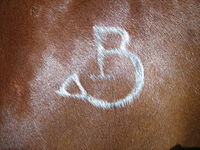
Freeze brand particular on shoulder of horse
In contrast to traditional hot-iron branding, freeze branding uses a branding iron that has been chilled with a coolant such every bit dry out ice or liquid nitrogen. Rather than called-for a scar into the animate being, a freeze make damages the pigment-producing pilus cells, causing the animal's hair to grow white where the make has been applied. Freeze brands cause less damage to the animals' hides than hot iron brands, and can be more than visible. Horses are frequently freeze-branded. At this fourth dimension, hogs cannot be successfully freeze branded, as their hair pigment cells are better protected. Also, freeze branding is slower, more expensive, less predictable (more care is required in application to assure desired results), and in some places does not constitute a legal make on cattle.[16] When an beast grows a long hair coat, the freeze make is even so visible, but its details are not always clear. Thus, it is sometimes necessary to shave or closely trim the pilus and then that a sharper image of a freeze make tin can exist viewed.
To utilise a freeze brand, all hair is shaved at the branding site. This is considering hair is an excellent insulator, and must exist removed so the farthermost cold of the freeze branding iron can be applied direct to the skin. The iron, fabricated of metal such as brass or copper that removes heat quickly from the skin, is submerged into the coolant. Immediately earlier the fe is applied, the animal's skin is rubbed, squirted, or sprayed with a generous amount of 99% alcohol, and so the freeze branding atomic number 26 is removed from the coolant and held onto the pare with house pressure for several seconds. The exact amount of time will vary co-ordinate to the species of the fauna, the thickness of its skin, the type of metal the branding iron is made of, the blazon of coolant being used, and the colour of its hair coat. Because a freeze-branded pilus follicle regrows as white hair, a light-haired animal will have a freeze brand kept on the skin longer than does a night-haired beast, so as to eliminate the hair follicle altogether and permit blank pare to prove the brand.
Also livestock, freeze branding can as well exist used on wild, hairless animals such as dolphins for purposes of tracking individuals.[17] [18] [nineteen] The brand appears equally a white mark on their blank skin and tin can last for decades.[xx]
Immediately after the freeze branding iron is removed from the skin, an indented outline of the brand will be visible. Within seconds, however, the outline volition disappear and within several minutes afterward that, the brand outline volition reappear every bit swollen, puffy peel. In one case the swelling subsides, for a brusk time, the brand will be difficult or impossible to see, simply in a few days, the branded pare will begin to flake, and within iii to four weeks, the brand volition begin to take on its permanent appearance.
Horse branding regulations [edit]


In Commonwealth of australia, all Arabian, Role Bred Arabians, Australian Stock Horses,[21] Quarter Horses,[22] Thoroughbreds,[23] must be branded with an owner brand on the nearly (left) shoulder and an individual foaling drop number (in relation to the other foals) over the foaling twelvemonth number on the off shoulder. In Queensland, these three brands may be placed on the near shoulder in the above order. Stock Horse and Quarter Horse classification brands are placed on the hindquarters by the classifiers.
Thoroughbreds and Standardbreds in Commonwealth of australia and New Zealand are freeze branded. Standardbred brands are in the course of the Alpha Angle Branding System (AABS),[24] which the Usa also uses.[25] [26]
In the United States, branding of horses is not more often than not mandated by the government; however, in that location are a few exceptions: captured Mustangs made available for adoption by the BLM are freeze branded on the cervix, usually with the AABS or with numbers, for identification. Horses that test positive for equine infectious anemia, that are quarantined for life rather than euthanized, volition be freeze branded for permanent identification. Race horses of any breed are usually required by state racing commissions to have a lip tattoo, to exist identified at the track. Some brood associations have, at times, offered freeze branding as either a requirement for registration or but equally an optional benefit to members, and individual horse owners may choose branding as a means past which to permanently identify their animals. As of 2011, the event of whether to mandate horses be implanted with RFID microchips under the National Animal Identification System generated considerable controversy in the United States.
-

-

-

-

-

-

-

Numerical freeze brand
Symbols and terminology [edit]
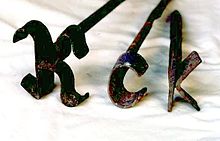

Branding fe from Swedish stallion depot.
Most brands in the United States include uppercase messages or numerals, often combined with other symbols such as a slash, circle, one-half circle, cross, or bar. Brands of this blazon have a specialized language for "calling" the brand. Some owners prefer to use simple pictures; these brands are chosen using a brusque description of the motion picture (e.g., "rising lord's day"). Reading a brand aloud is referred to every bit "calling the make". Brands are chosen from left to correct, top to bottom, and when one graphic symbol encloses another, from exterior to within.[27] Reading of complex brands and picture brands depends at times upon the owner's interpretation, may vary depending upon location, and it may require an proficient to identify some of the more circuitous marks.
In full general, the post-obit usage of the term "symbol" usually means a capital letter of the alphabet. Uncapitialized letters are not used. Brands are ordinarily "read" top to bottom and left to correct. There are regional variations in how brands are read, and deference is given to the terminology preferred by the owner of the make. Terms used include:
- "Bar": a short horizontal line. For example, a short horizontal line over an M or before an M would be read as "Bar M". Similarly, a short horizontal line under an M or after an Yard would be read as "M Bar". The bar can also be through the middle of the symbol and would be read as "Bar Yard".
- "Rail" is alternative terminology to "bar" in some areas referencing a long horizontal line. For instance, a long horizontal line over a M or before an G would be read as "Rail M". Similarly, a long horizontal line under a M or after a Thousand would be read as "M Runway".
- "Box": a symbol within a square or rectangle or a square or rectangle by itself. A box with a P inside of information technology would be read as "Box P".
- "Circle": a symbol inside a circle, or a circumvolve by itself. A circle with a C inside of it would be read every bit "Circle C".
- "Half Circle or Quarter Circle": a half or quarter circumvolve above or below a symbol, but not touching the symbol. A K with a half circle above it, open side facing upwards, would be read as "One-half Circle K". A K with a half circle beneath information technology, open side facing down, would be read as "K One-half Circle". See Rocking beneath if the circle touches the symbol.
- "Crazy": An upside down symbol. An upside down R would be read as "Crazy R".
- "Cantankerous": a plus sign. +
- "Diamond": a symbol inside a iv sided box, the box tilted 45 degrees or a four sided box tilted 45 degrees by itself. The box sides are of equal length, and the box can be square or taller in height than in width, or greater in width than in summit. A rafter tin can besides be read as a "Half Diamond".
- "Flying": a symbol that starts and ends with a short serif or short horizontal line attached before the left side of the superlative of the symbol and attached later on the right side of the top of the symbol, extending to the right of the symbol.
- "Lazy": Symbols turned 90 degrees. A symbol turned ninety degrees, lying on its face (or right hand side) can be read equally "Lazy Down" or "Lazy Right". Similarly, a symbol turned 90 degrees, lying on its back (or left mitt side) can be read as "Lazy Upward" or "Lazy Left".
 could be read as "Lazy five" or "Lazy Up five" or Lazy Left v".
- "Over": a symbol over and above some other symbol, but not touching the other symbol. An H to a higher place a P would be read every bit "H Over P".
- "Rafter or One-half-diamond": Ii slashes joined at the peak. ∧ An R with ii slashes joined at the top would be read equally "Rafter R"
- "Contrary": A reversed symbol.
 would be read as "Reverse K". Reverse is sometimes chosen "Dorsum" (i.east. a backwards C would be read as "Back C").
-
- "Crazy Reverse": An upside downward, reversed symbol. An upside downwardly, reversed R would exist read equally "Crazy Reverse R"
- "Running": a letter of the alphabet with a curving flare attached to the right side of the tiptop of the letter, extending to the correct, with the symbol sometimes also leaning to the right like an italic letter.
- "Slash": A forrard or reverse slash. / \ .
- "Tumbling": a symbol tipped to the right near 45 degrees.
- "Walking": a symbol with a curt horizontal line attached to the bottom of the symbol, extending to the right of the symbol.
Combinations of symbols can be made with each symbol distinct, or:
- "Connected" or conjoined, with symbols touching.
 would exist read equally "T S connected" or "TS conjoined".
- "Combined or conjoined": symbols are partially overlaid.
 would be read as "J M Combined".
- "Hanging": a symbol beneath some other symbol and touching the other symbol. The hanging nomenclature may be omitted when reading the brand, such as a H with a P below it, with the tiptop of the P touching the bottom of the right hand side of the H would be read every bit " H Hanging P", or just "H P".
- "Swinging": a symbol beneath a quarter circle, the open side of the quarter circle facing the symbol, with the symbol touching the quarter circle. For example, a H with a quarter circle over information technology, with the top of the H touching the quarter circle would be read every bit "Swinging H".
- "Rocking": a symbol higher up a quarter circle, the open side of the quarter circle facing the symbol, with the bottom of the symbol touching the quarter circumvolve. For example, a H with a quarter circle under information technology, with the bottom of the H touching the quarter circle, is read as "Rocking H".
Animal welfare concerns [edit]
Livestock branding causes pain to the animals being branded, seen in behavioural and physiological indicators. Both hot and freeze branding produce thermal injury to the skin, only hot-iron branding creates more inflammation and pain than freeze branding does.[28] Although alternative methods of identification such every bit ear tags are suggested, the practise of branding is still mutual worldwide.[29]
Standard hot atomic number 26 branding tin take almost 8 weeks to heal. Use of analgesics helps reduce discomfort.[30] Topical treatments such as cooling gels helps speed healing in pigs, but results are less clear for cattle.[31] Common concerns include how long the animal is restrained, size and location of the brand, and whether analgesics are applied for pain relief. A 2018 report in Sri Lanka, where hot-iron branding is illegal simply withal widely practiced, concluded that it impairs brute welfare and that at that place is no real manner to improve the procedure.[29] Yet, this particular study looked at four small dairy farms that used a technique where multiple applications of irons ("drawing") created large brands extended across the ribs and took at to the lowest degree a full infinitesimal to apply and 10 weeks to heal. In contrast, in nations such every bit the United States and Australia, pre-shaped brands are used to stamp the brand on an brute, practical for merely 1-5 seconds. Although branding is painful, from a welfare perspective, stamping is preferable over drawing, as less time is needed to utilize the brand.[29]
See besides [edit]
- Animal identification
- Horse markings
- No. 87 Squadron RAF, whose "lazy-S" World War I unit insignia was derived from ranch branding past Joseph Callaghan.
- Scarification
- Animal abuse
- Human branding
- Veterinary ethics
References [edit]
- ^ Khan, S.U. and Mufti, O., "The Hot History and Common cold Future of Brands", Journal of Managerial Sciences, Vol. i, No. 1, 2007, p. 76
- ^ Eva D'Ambra, "Racing with Death: Circus Sarcophagi and the Celebration of Children in Roman Italian republic" in Constructions of Babyhood in Ancient Greece and Italian republic (American School of Classical Studies at Athens, 2007), p. 351.[ ISBN missing ]
- ^ The Cowboy at Piece of work - Fay E. Ward - Google Books[ ISBN missing ]
- ^ The Cowboy at Piece of work - Fay East. Ward - Google Books
- ^ Barbwire Museum (via archive.org)
- ^ Anderson, Terry Lee & Leal, Donald (2001). Free Market Environmentalism. p. 32. ISBN0-312-23503-8.
- ^ "Glossary of Meat Terminology". USDA Agricultural Market place Service. Archived from the original on March 22, 2009. Retrieved May 2, 2007.
- ^ Pritchard, Peter C. H. (Apr 23, 2009). "Summary Written report of Galapagos Trek – December 2008". Chelonian Research Plant. world wide web.chelonianri.org. Archived from the original on Baronial thirteen, 2011. Retrieved iv January 2018.
- ^ Vereker, James (September–October 2011). "Bronco Branding". Australian Horseman. 12 (ii): 24–26.
- ^ Examples of hoof brands and what they expect like when practical (commercial site)
- ^ "Falkland". Equestrian Life (August/September 2011): 9. 2011.
- ^ "Livestock Identification Service". Applying Brands: Hot Iron Branding. world wide web.lis-alberta.com. Retrieved 4 January 2018.
- ^ Neary, Michael and Yager, Ann. "Methods of Livestock Identification", Farm Beast Management @ Purdue. Purdue Academy, ii December, 9 October 2012. extension.purdue.edu
- ^ Bureau of Creature Welfare, Attwood. "Code of accustomed farming practice for the welfare of goats." Agriculture. August 2001. 9 Oct 2012. dpi.vic.gov.au
- ^ Schoenian, Susan. "Animal Identification and Record Keeping." Sheep 201 A Beginner'south Guide to Raising Sheep. i March 2011. nine October 2012.sheep101.info
- ^ California Dept. of Food and Agriculture statement on freeze branding cattle, Accessed September nineteen, 2007
- ^ Odell, Dan. "Dolphin Watch affiliate 2". Retrieved 1 June 2014.
- ^ "About Us: Program Operations". Sarasota Dolphin Research Program. Retrieved ane June 2014.
- ^ O'Barry, Ric (17 Apr 2014). "Jedol and Sampal Are Free – We Have Proof!". Dolphin Project. Retrieved 1 June 2014.
- ^ Mckelvey, Wallace (2012-08-04). "Dolphin 56, where are you?". Associated Press. Retrieved 1 June 2014.
- ^ ASH Society
- ^ AQHA Rule Book Retrieved on 24 Oct 2008
- ^ "Rules & Regulations". Australian Pony Stud Volume Society. www.apsb.asn.au. Retrieved March 16, 2020.
- ^ Alpha Angle Branding System Archived 2008-09-08 at the Wayback Motorcar Retrieved on 24 October 2008
- ^ UStrotting.com Retrieved on 24 Oct 2008
- ^ Standardbred Brands Retrieved on 24 Oct 2008
- ^ Article on reading and recording Livestock Brands
- ^ Schwartzkopf-Genswein, G. S.; Stookey, J. One thousand. (one December 1997). "The use of infrared thermography to assess inflammation associated with hot-iron and freeze branding in cattle". Canadian Journal of Brute Science. 77 (iv): 577–583. doi:10.4141/A97-019. ISSN 0008-3984. Retrieved 24 Jan 2021.
- ^ a b c Adcock, Sarah J. J.; Tucker, Cassandra B.; Weerasinghe, Gayani; Rajapaksha, Eranda (August 2018). "Branding Practices on 4 Dairies in Kantale, Sri Lanka". Animals. 8 (8): 137. doi:10.3390/ani8080137. PMC6115924. PMID 30087245.
- ^ Tucker, C. B.; Mintline, Due east. Thousand.; Banuelos, J.; Walker, K. A.; Hoar, B.; Varga, A.; Drake, D.; Weary, D. M. (Dec 2014). "Pain sensitivity and healing of hot-iron cattle brands". Journal of Animal Science. 92 (12): 5674–5682. doi:10.2527/jas.2014-7887. ISSN 1525-3163. PMID 25403196. Retrieved 24 January 2021.
- ^ Tucker, C. B.; Mintline, E. Grand.; Banuelos, J.; Walker, K. A.; Hoar, B.; Drake, D.; Weary, D. M. (December 2014). "Consequence of a cooling gel on pain sensitivity and healing of hot-fe cattle brands". Periodical of Animal Science. 92 (12): 5666–5673. doi:10.2527/jas.2014-7860. PMID 25414112. Retrieved 24 January 2021.
Source: https://en.wikipedia.org/wiki/Livestock_branding

Post a Comment for "Beef Cattle Branding Areas Beef Cattle Branding Areas Labled"